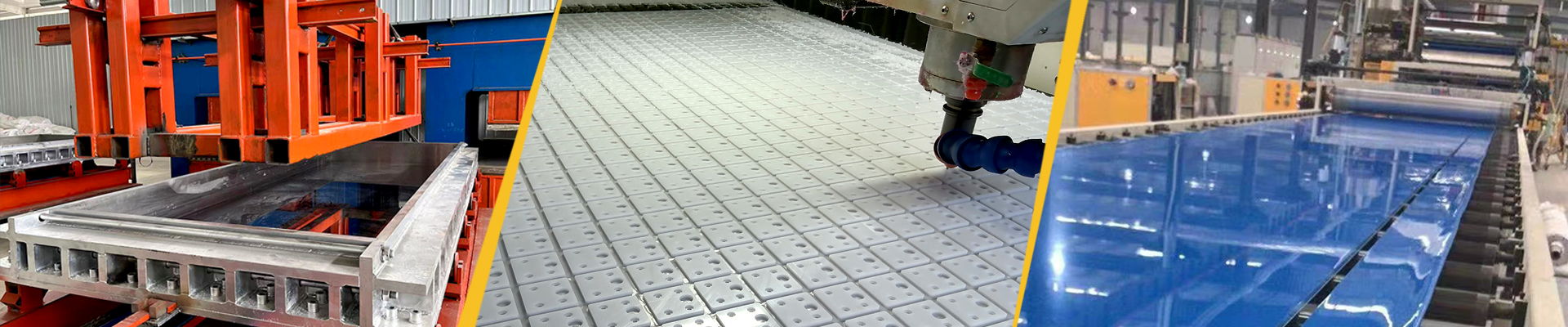
This article explores how the HDPE sheets factory of Guangzhou uhmw-pe co.,ltd tests for impact strength and dimensional stability. The factory uses standard methods like Izod and Charpy impact tests, drop weight tests, and instrumented impact testing to measure toughness. For dimensional stability, they perform thermal expansion, heat deflection temperature, humidity tests, and flatness checks. The company's ISO 9001-certified quality system ensures rigorous raw material, in-process, and final inspections. With advanced modification capabilities and large-scale production lines, they deliver consistent, high-performance HDPE sheets for ground protection mats, synthetic ice rinks, and other demanding applications. Their testing protocols guarantee products that withstand harsh conditions and maintain their shape, providing customers with reliable, cost-effective solutions.
At Guangzhou uhmw-pe co.,ltd, a leading manufacturer of high-performance engineering plastics located in Guangzhou, China, quality control is paramount. The company specializes in HDPE sheets and other advanced plastic materials, serving industries from construction to mining. To ensure their products meet rigorous standards, the factory employs a series of tests for impact strength and dimensional stability. This article delves into the specific methodologies used, from raw material selection to final inspection, highlighting the expertise and state-of-the-art equipment that set Guangzhou uhmw-pe co.,ltd apart.
The Importance of Impact Strength and Dimensional Stability
HDPE (High-Density Polyethylene) sheets are prized for their toughness, chemical resistance, and durability. However, not all HDPE sheets are created equal. Impact strength determines how well the material withstands sudden forces without cracking or breaking, while dimensional stability ensures the sheet maintains its shape and size under varying temperatures and mechanical loads. For applications like ground protection mats, outrigger pads, and synthetic ice rink boards, these properties are critical to safety and performance.
Guangzhou uhmw-pe co.,ltd positions itself as a full-chain supplier, offering customized solutions. Their testing protocols are designed to verify that every batch of HDPE sheets meets the required specifications, whether for standard products or custom-shaped parts like guide rails and wear-resistant liners.
undefined
Testing for Impact Strength
Izod and Charpy Impact Tests
The factory primarily uses the Izod and Charpy impact tests, which are standardized methods under ASTM D256 and ISO 179 respectively. In these tests, a notched specimen of the HDPE sheet is struck by a pendulum. The energy absorbed during fracture is measured in joules per meter or kilojoules per square meter. Guangzhou uhmw-pe co.,ltd conducts these tests at controlled temperatures, often at 23°C and -40°C, to simulate real-world conditions. The results provide data on the material's toughness and its ability to perform in cold environments.

Drop Weight Impact Test
For applications like ground protection mats that experience dynamic loads, the factory employs a drop weight impact test (ASTM D5628). A weighted tup is dropped from a specific height onto the HDPE sheet. The test measures the energy required to cause failure, and the type of failure (ductile or brittle) is recorded. This test is particularly relevant for products that must withstand heavy equipment traffic.
Instrumented Impact Testing
To gain deeper insights, Guangzhou uhmw-pe co.,ltd uses instrumented impact testing. This method records force-time and energy-time curves, allowing engineers to analyze the material's behavior during impact. It helps distinguish between crack initiation and propagation, guiding material formulation improvements. The company's R&D team uses this data to optimize their UHMwPE and HDPE blends, ensuring consistent performance across different batches.
Testing for Dimensional Stability
Thermal Expansion and Contraction
Dimensional stability is assessed through thermal expansion tests. HDPE sheets have a relatively high coefficient of thermal expansion, which can cause warping or buckling if not accounted for. The factory uses a dilatometer to measure linear expansion over a temperature range from -40°C to 80°C. Results are used to calculate expansion coefficients and inform installation guidelines for products like synthetic ice rink boards and lining sheets.
Heat Deflection Temperature (HDT) Test
The HDT test (ASTM D648) measures the temperature at which a test bar deflects by a specified amount under a load. Guangzhou uhmw-pe co.,ltd performs this test on HDPE sheets to determine their resistance to deformation at elevated temperatures. This is crucial for applications near heat sources or in direct sunlight. The company's materials typically exhibit HDT values between 50°C and 80°C, depending on the grade.
Dimensional Stability under Humidity
HDPE is generally moisture-resistant, but for applications in high-humidity environments, the factory conducts moisture absorption tests. Samples are conditioned at 50% and 100% relative humidity, and changes in dimensions are recorded over 48 hours. The results confirm that Guangzhou uhmw-pe co.,ltd's HDPE sheets remain dimensionally stable, with negligible swelling, meeting the needs of the food processing and marine industries.
Warpage and Flatness Checks
Using precision measurement tools like dial gauges and flatness testers, the factory inspects every sheet for warpage. For large-format sheets up to 6 meters in length, the company employs laser scanning systems to ensure flatness within tolerances. This is especially important for products like outrigger pads, which must sit perfectly level on uneven ground.
Quality Control Infrastructure
Guangzhou uhmw-pe co.,ltd operates multiple international-grade extrusion and mould pressing lines, complemented by a comprehensive testing laboratory. The quality management system is certified to ISO 9001, and the company can provide third-party test reports from SGS, ROHS, and FDA. Every step from raw material selection to final inspection is governed by strict protocols. The factory's team of material scientists and mechanical engineers ensures that testing data is meticulously recorded and analyzed, enabling continuous improvement.
Raw Material Incoming Inspection
Before production, each batch of HDPE resin is tested for melt flow index (MFI) and density. Only materials meeting the specifications are approved for extrusion. This prevents variability in the final sheets.
In-Process Monitoring
During extrusion, parameters like temperature, pressure, and cooling rate are monitored in real-time. Samples are taken every hour for quick impact and dimensional checks. If any deviation is detected, adjustments are made immediately.
Final Inspection
Finished sheets undergo a battery of tests: impact strength, dimensional stability, surface finish, and thickness uniformity. Each sheet is marked with a unique batch number, allowing full traceability. Products destined for export are packaged with care to maintain dimensional integrity during shipping.
Customization and Modification Capabilities
One of Guangzhou uhmw-pe co.,ltd's strengths is its ability to modify HDPE properties. Through compounding, they can produce sheets with enhanced impact resistance or lower thermal expansion. For example, adding glass fibers increases stiffness but may reduce impact strength; the company balances these trade-offs based on customer requirements. Their testing facilities validate these modifications, ensuring that custom formulations meet the promised performance.
Real-World Applications and Case Studies
The impact and dimensional stability tests directly benefit end-users. For instance, ground protection mats from Guangzhou uhmw-pe co.,ltd have been used in construction sites across Southeast Asia, where they withstand heavy loads and variable weather. The mats' consistent impact strength prevents cracking, while their dimensional stability ensures they interlock properly. Similarly, synthetic ice rink boards maintain their flatness and glide characteristics even in fluctuating temperatures, thanks to rigorous HDT testing.
Conclusion
Testing for impact strength and dimensional stability is not just a routine procedure at Guangzhou uhmw-pe co.,ltd—it is a commitment to quality. By employing standard and advanced testing methods, the factory ensures that every HDPE sheet delivers the reliability and performance that industries demand. With a focus on innovation and customer satisfaction, they continue to set benchmarks in the engineering plastics sector.