Urban landscape projects need to protect tree-root areas while keeping sidewalks and public spaces practical to use. A well-specified tree grate can help define the planting zone, create a more orderly paved environment, and reduce direct foot traffic over exposed soil. For projects considering polymer components, HDPE tree grate covers are worth evaluating for their wear resistance, tensile strength, and customization potential.
Guangzhou UHMW-PE Co., Ltd. lists HDPE Tree Grate Covers in its product range and identifies wear resistance, high tensile strength, and custom color, size, and thickness as product features. This guide explains the key design and purchasing questions landscape contractors, urban furniture suppliers, municipal project teams, and OEM buyers should review before specifying a custom HDPE tree grate.
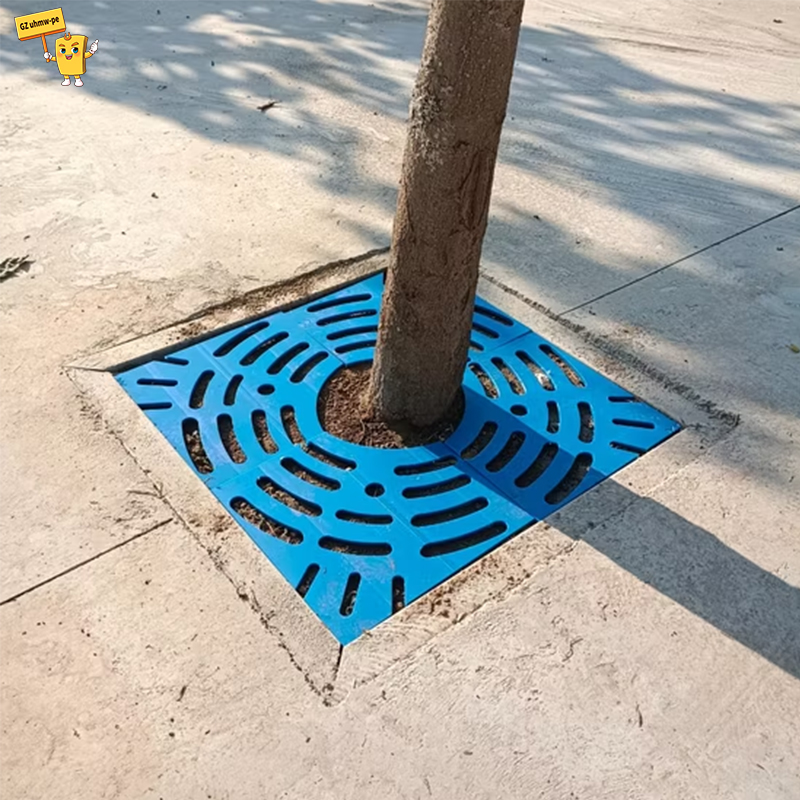
HDPE tree grate cover concept for an urban sidewalk and landscape project.
Table of Contents
- What Is an HDPE Tree Grate Cover?
- Why Consider HDPE for Tree Grate Applications?
- HDPE Material Data to Review
- Five Design Checks Before Ordering
- Custom Sizes, Colors, and Thickness
- Installation and Maintenance Considerations
- What Buyers Should Include in an RFQ
- Frequently Asked Questions
- Conclusion
What Is an HDPE Tree Grate Cover?
A tree grate is a panel or panel assembly fitted around the base of a tree, commonly within a paved streetscape, plaza, pedestrian area, or landscaped public space. Its central opening accommodates the tree trunk, while the surrounding surface helps create a defined transition between the planting area and adjacent paving.
An HDPE tree grate cover uses high-density polyethylene as its base material. The finished component may be designed as one panel or as multiple sections, depending on the tree opening, installation space, support arrangement, and maintenance requirements. The exact panel layout, slot pattern, fastening method, and load capacity should be confirmed in the project drawing rather than assumed from the material name alone.
For buyers, the important point is that a tree grate is not simply a flat plastic sheet with a hole. It is a purpose-designed component. Its geometry, support conditions, surface finish, and installation details all influence how it performs in the completed landscape.
Why Consider HDPE for Tree Grate Applications?
HDPE is used across outdoor and industrial applications because it combines useful mechanical properties with practical fabrication options.
Wear resistance for everyday contact
Tree grates in public spaces may experience repeated contact from pedestrians, maintenance equipment, cleaning tools, and movable street furniture. A wear-resistant material is therefore an important consideration when selecting a grate component. The actual service performance will still depend on the panel design, surface texture, installation, and intensity of use.
Strength must be considered together with geometry
Material strength is only one part of a finished grate's performance. Openings, ribs, panel spans, edge details, and the way the grate is supported all affect how loads are transferred. Buyers should request project-specific structural information and should not treat a raw-material tensile value as a certified pedestrian or vehicle load rating.
Fabrication flexibility for project layouts
Urban planting pits rarely share one universal size. A project may involve different tree-pit dimensions, curb details, paving modules, or existing site constraints. The product listing identifies custom sizes, colors, and thicknesses as available options, making a drawing-based quotation a practical starting point for non-standard layouts.
HDPE Material Data to Review
| Test item | Test method | Unit | Listed value |
|---|---|---|---|
| Density | ASTM D1505 | g/cm³ | 0.96 |
| Melt Index | ASTM D1238 | g/10 min | 0.5 |
| Environmental Stress-Crack Resistance, Condition A | ASTM D1693 | h | >500 |
| Tensile Yield Strength | ASTM D638, Type IV | MPa | 26 |
| Elongation at Break | ASTM D638, Type IV | % | >300 |
| Brittleness Temperature | ASTM D746 | °C | <-40 |
| Flexural Modulus, Tangent | ASTM D790 | MPa | 950 |
| Shore D Hardness | ASTM D2240 | — | 65 |
Important specification note: Confirm the current material grade, test conditions, tolerances, and applicable documentation with the supplier before using these values in a tender or engineering specification. The listed material data does not establish the allowable load of a completed tree grate assembly.
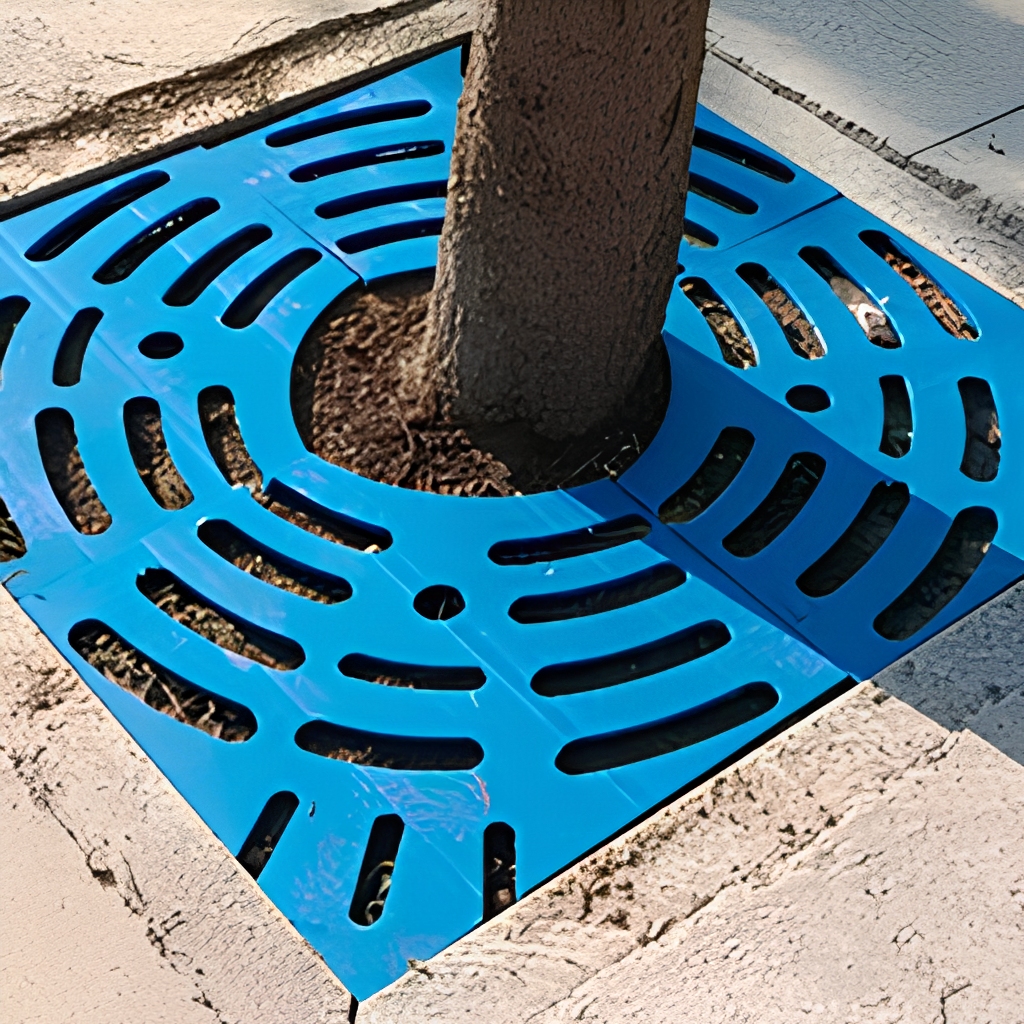
Panel layout and the tree opening should be coordinated with the site dimensions and support design.
Five Design Checks Before Ordering
1. Tree opening and future growth clearance
Specify the opening diameter or shape around the trunk, and coordinate it with the tree species, current trunk size, expected growth, and the landscape designer's requirements. The opening should not be sized only from a photograph or an approximate field measurement. Confirm whether an adjustable, removable, or replaceable inner section is required for future maintenance.
2. Panel dimensions and support conditions
Provide the overall tree-pit dimensions, panel spans, edge support details, frame or substructure information, and any constraints created by nearby paving. A panel that fits the opening but lacks suitable support may not perform as intended. The supplier and project engineer should review the complete assembly.
3. Slot pattern, drainage, and access to the soil
Define the required opening pattern and clear opening dimensions. The design team should check how the selected pattern supports the project's drainage, irrigation, soil access, and maintenance plan. Do not assume that every grate pattern provides the same water or air movement; verify the open area and underlying construction for the specific design.
4. Surface safety and applicable load class
Identify who and what will use the area: pedestrians, bicycles, cleaning machines, landscape carts, or occasional service vehicles. Ask for evidence that the complete grate, frame, and support arrangement is suitable for the intended load category. Review slip resistance, edge transitions, openings, trip hazards, and local accessibility requirements with the responsible project professional.
5. Outdoor exposure and dimensional movement
Record the expected temperature range, direct sunlight exposure, cleaning chemicals, moisture, and local climate. Polyethylene components can change dimensions with temperature, so the design should allow for the movement expected from the selected material and panel size. Ask the supplier to confirm the recommended clearances and fastening approach for the intended installation.
Custom Sizes, Colors, and Thickness
The product listing identifies custom color, size, and thickness as available options. To make this customization useful, buyers should provide a dimensioned drawing rather than a general request for a “standard tree grate.” Include the tree opening, outer dimensions, panel segmentation, corner details, fixing locations, surface pattern, and any required edge treatment.
Color selection should be coordinated with the paving, street furniture, and landscape palette. If color consistency is important across multiple delivery batches, request an agreed color reference and a sample approval process. Thickness should be selected according to the panel geometry, support spacing, design loads, and engineering review—not simply chosen by copying a different project's specification.
Where the grate has an unusual outline or needs accurately positioned slots and fixing holes, ask whether the supplier can review the drawing and confirm the proposed fabrication method. The website also presents CNC machining and custom component manufacturing as part of its wider engineering-plastics capabilities.
Installation and Maintenance Considerations
- Check the site opening: Verify the finished tree-pit dimensions and the condition of the supporting frame before installation.
- Confirm the support: Install the grate only on the support arrangement approved for the project. Do not rely on unsupported edges or improvised packing.
- Allow for movement: Follow the supplier's recommendations for clearances, joints, and fastening so the panel can accommodate expected thermal movement.
- Keep the tree opening clear: Inspect the trunk clearance periodically and remove debris that could obstruct maintenance access or drainage paths.
- Inspect after service work: Recheck panel seating, fasteners, edges, and surrounding paving after irrigation, utility, or landscaping work.
Maintenance frequency should reflect site traffic, exposure, and local operating requirements. A simple inspection plan can help identify loose panels, damaged edges, blocked openings, or changes in the surrounding pavement before they become larger problems.
What Buyers Should Include in an RFQ
A complete request for quotation helps the supplier evaluate the project and reduces the risk of mismatched assumptions. Include the following information wherever possible:
- Project location and intended application.
- Tree-pit opening dimensions and overall grate dimensions.
- Dimensioned drawings showing panel sections, slots, edges, and fixing points.
- Required material grade, color reference, and thickness range.
- Expected pedestrian, maintenance, or vehicle loading conditions.
- Support frame details and installation method.
- Outdoor exposure, temperature range, and cleaning conditions.
- Quantity, prototype or sample needs, packaging, and delivery destination.
- Required test reports, inspection records, and project compliance documents.
For a product overview, visit HDPE Tree Grate Covers. For a project-specific discussion or quotation, contact the UHMW-PE team with your drawings and application details.
Frequently Asked Questions
Are HDPE tree grate covers available in custom dimensions?
The product page lists custom sizes, colors, and thicknesses. Send the required dimensions and a drawing to confirm whether the proposed configuration can be produced.
What technical data is available for the HDPE tree grate material?
The product page publishes values for density, melt index, tensile yield strength, elongation at break, brittleness temperature, flexural modulus, Shore D hardness, and environmental stress-crack resistance. Request the current datasheet and confirm the grade and test conditions before specification.
Can the material data be used as the grate's load rating?
No. Material test values describe specific properties of a test specimen. The load capacity of a finished grate depends on its geometry, openings, thickness, support span, frame, fasteners, and installation. Request project-specific engineering evidence for the complete assembly.
How should the tree opening be selected?
Coordinate the opening with the tree's current size, expected growth, species, and the landscape maintenance plan. The project designer should define the required clearance and whether a removable or adjustable section is needed.
What information should I send when requesting a quotation?
Provide a dimensioned drawing, quantity, material and color preferences, intended loading conditions, support details, project location, and any required compliance documents. These details help the supplier review the application more accurately.
Conclusion
HDPE tree grate covers can be considered for urban landscape and streetscape projects where wear resistance, material strength, and made-to-order dimensions are important. The UHMW-PE product listing provides a starting point with published HDPE material data and customization options. The final specification should still be based on the complete grate design, tree-growth clearance, support arrangement, drainage needs, surface safety, and the project's required load class.
Planning a custom tree grate project? Review the HDPE Tree Grate Covers and contact Guangzhou UHMW-PE Co., Ltd. with your drawings, dimensions, and application requirements to discuss a suitable configuration.
Related Product: HDPE Tree Grate Covers